Sizing a signalling backup battery is a derating exercise wrapped in a safety case: the nominal energy that looks adequate on a spreadsheet at 25 degrees C must still carry the safety-related load at the end of the battery's life, in the coldest credible cabinet, after months of idle float service. This second paper develops a sealed nickel-metal hydride pack for a wayside cabinet hosting an LEU and controlled balise, an axle-counter evaluator, interlocking communication interfaces and, where present, a level-crossing controller. It works through the autonomy calculation in the order a signalling integrator must: list the backed loads and their duty, sum the energy over the documented time-to-restore window, convert to a required delivered capacity at the worst-case temperature and end of life, choose the string voltage to sit inside the electronics' allowed bus range across the full discharge, and add pulse-current margin for crossing or point events. It then addresses the architecture that is unique to standby service - a charger that keeps the pack fully ready without overcharging it during years of float, low-self-discharge cells that make long idle periods credible, and supervision that records mains-loss events and remaining autonomy. The paper places sealed NiMH candidly against the three chemistries a railway engineer will already know: vented (pocket- or sintered-plate) nickel-cadmium, the historic rail battery standardised in IEC 62973-2 and valued for extreme temperature and abuse tolerance but needing water maintenance and carrying cadmium; valve-regulated lead-acid, cheap and familiar but heavier, colder-weaker and shorter-lived in deep or float cycling; and lithium-ion, now addressed by IEC 62973-5 for rolling stock, energy-dense but requiring a managed battery system and a more complex thermal and safety case. For small, distributed, maintenance-poor wayside cabinets, sealed NiMH under the railway battery framework offers a defensible balance.
The calculation starts from the load list, not the battery catalogue. Each backed function contributes an average power - the LEU and balise up-link, the axle-counter evaluator and detectors, interlocking communications, cabinet heaters or ventilation where these are safety-relevant - and an event energy for periodic high-current loads such as a barrier drive. Energy over the autonomy window is the integral of standby power across time plus the sum of event energies for the number of activations assumed in the worst-case outage.
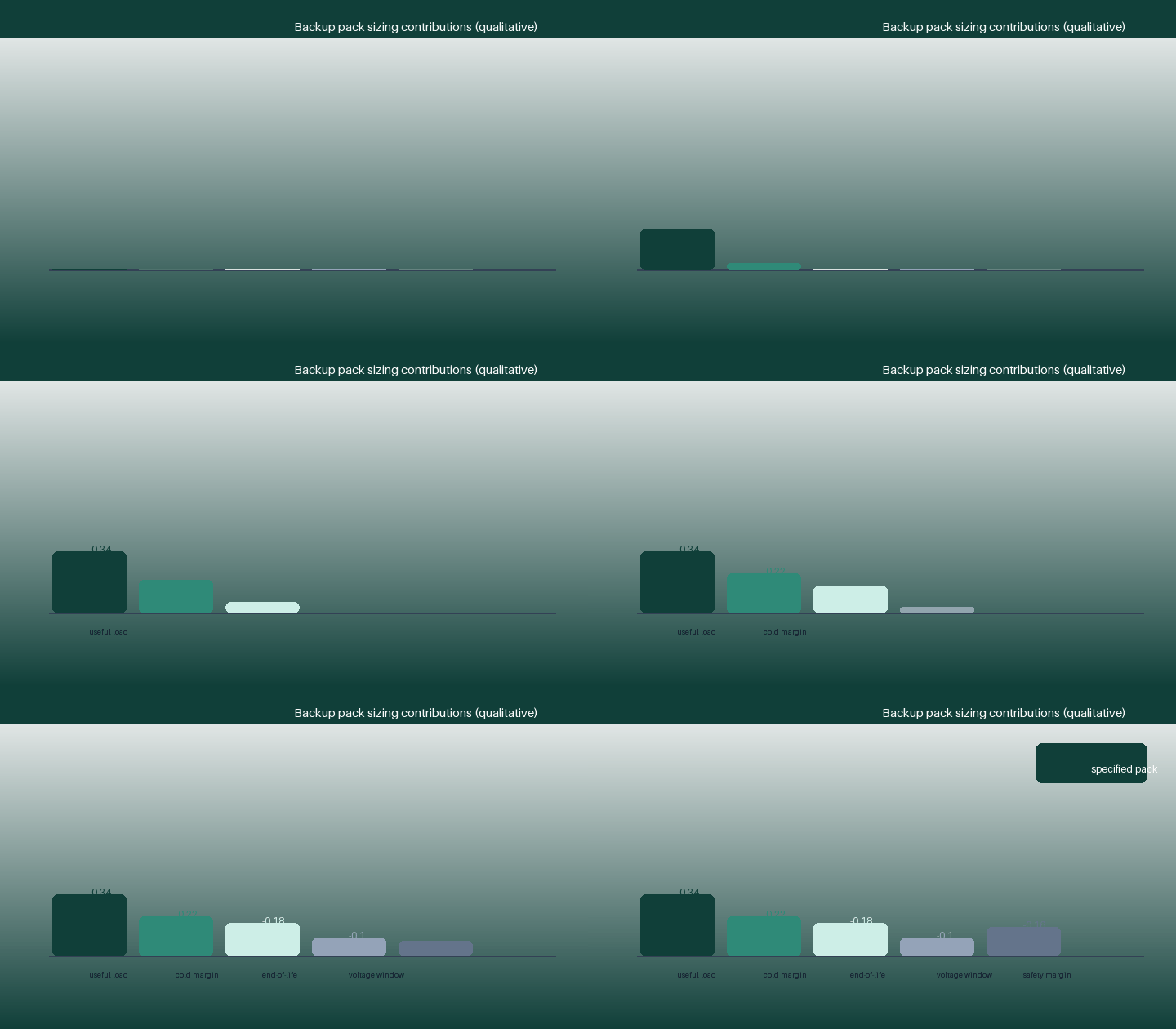
That delivered-energy requirement is then converted to a nameplate capacity through a stack of deratings: a temperature factor for the minimum cabinet temperature (electrochemical capacity falls in the cold), an end-of-life factor reflecting capacity fade after the rated years and cycles, a design margin demanded by the safety case, and the usable-window factor imposed by the load's minimum bus voltage. The first animated figure builds this derating stack; the nameplate capacity is always markedly larger than the raw energy sum, and presenting the raw sum as the battery size is a classic failure mode.
Wayside electronics are commonly fed from a nominal 24 V or 48 V DC cabinet bus (with 12 V logic downstream), and the battery must keep that bus inside the load's permitted window from the fully charged to the end-of-discharge point. Sealed NiMH's flat 1.2 V per cell gives a predictable string voltage - for example twenty cells for a nominal 24 V bus - whose chief advantage is a long, stable plateau rather than the sloping voltage of lead-acid, which simplifies the DC-DC converter design and delays low-bus cut-out.
Pulse margin is checked separately from energy: even a pack with enough total energy can fail if a barrier motor or a cluster of warning lamps pulls the terminal voltage below cut-out for a few hundred milliseconds. The pack's internal resistance at low temperature and state of charge sets the voltage sag, so cells are chosen for low internal resistance and the string is verified against the worst simultaneous pulse rather than the average current. This is where consumer-grade NiMH and an industrial sealed cell diverge sharply.
A signalling backup spends almost all its life fully charged and waiting, which makes the charge regime decisive for service life. The charger provides the normal bus, floats or top-up charges the pack with a temperature-compensated, current-limited profile appropriate to sealed NiMH, and isolates or manages the pack so that years of standby cannot produce overcharge, dry-out or thermal stress. Low-self-discharge (LSD) NiMH chemistries retain the bulk of their charge over many months of idle, so the pack is genuinely ready after a long mains-free interval rather than quietly self-discharging to an unusable state.
Supervision closes the architecture: a controller logs mains loss and restoration, times the backup discharge, monitors cell/string voltage and temperature, raises a remote alarm if the autonomy used approaches the design value or the pack fails its periodic self-test, and - importantly for EN 50129 traceability - records that the backup function was available. Periodic, scheduled capacity verification can be automated or planned into maintenance, replacing the manual discharge tests that dominate the lifecycle cost of older chemistries.
Vented nickel-cadmium has been the default railway battery for decades and is standardised for rolling-stock auxiliary service in IEC 62973-2; it tolerates extreme temperature, mechanical abuse and electrical mistreatment with legendary robustness. For unattended wayside cabinets, however, its drawbacks are structural: flooded cells need electrolyte inspection and water top-up, they can emit gas requiring ventilation, they carry cadmium under increasingly restrictive environmental rules, and they are vulnerable to capacity loss from memory effects if not managed. A distributed network of remote cabinets multiplies every maintenance visit.
Sealed NiMH shares nickel chemistry's tolerance and flat voltage but removes the watering, the free electrolyte and the cadmium, making it attractive precisely where maintenance access is expensive. It does not quite match vented NiCd at the most extreme low temperatures or in the largest capacities, so the comparison is made per application: for small distributed signalling backups NiMH frequently wins on lifecycle cost and compliance, while very large, extreme-climate banks may still favour NiCd.
Valve-regulated lead-acid is cheap and familiar, but for wayside backup it is heavy, its capacity collapses in cold weather, its float life at elevated cabinet temperature is limited by grid corrosion and dry-out, and deep or repeated discharges shorten it quickly; it also contains sulphuric acid and gas. In a solar-heated or freezing unheated cabinet these weaknesses translate directly into more frequent replacement and a wider spread of real autonomy over life.
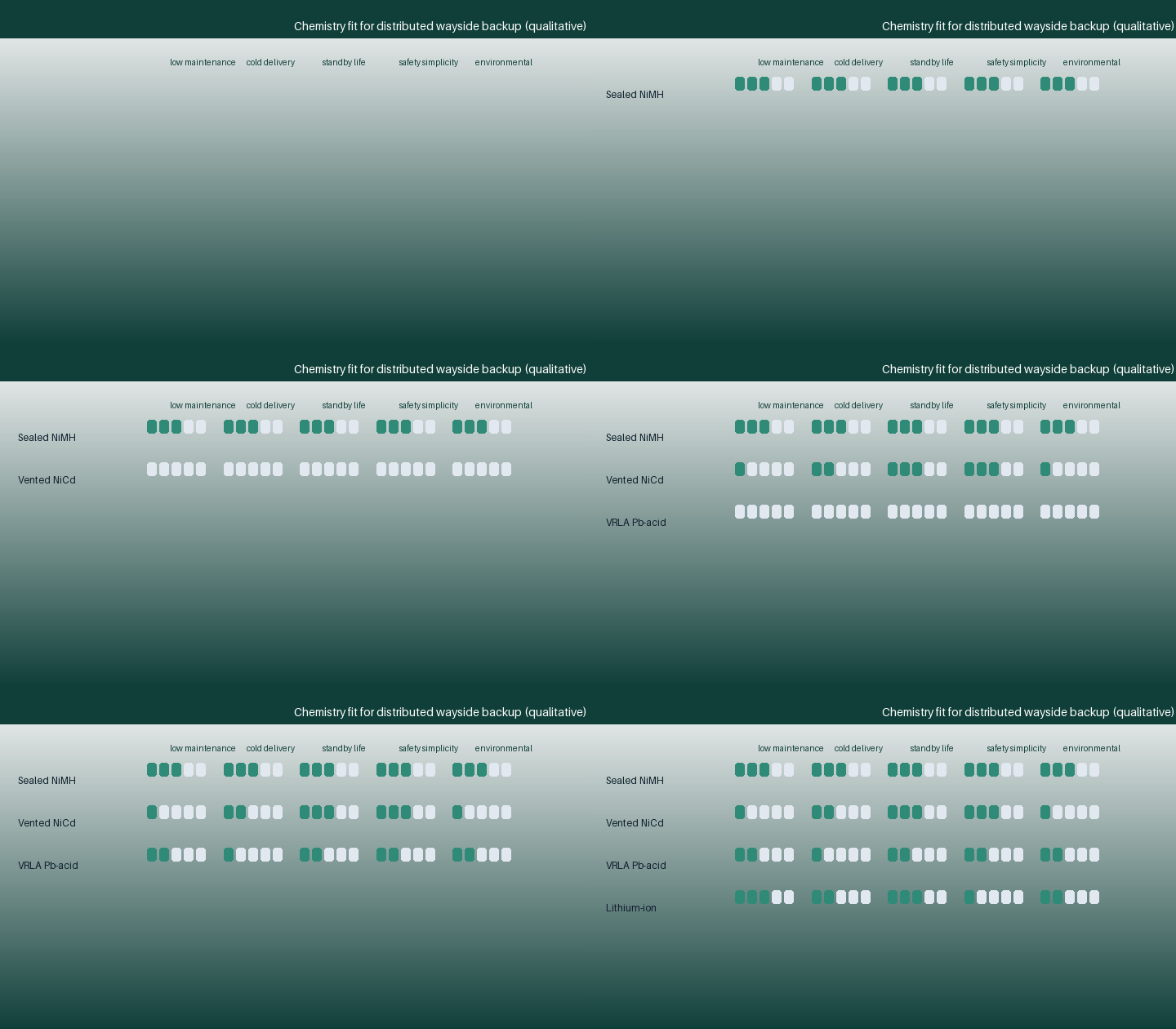
Lithium-ion offers the highest energy density and a flat, high cell voltage, and is now addressed for rolling-stock auxiliary batteries by IEC 62973-5, but it mandates a battery management system for cell balancing, over-charge/discharge and thermal protection, and its safety case for unattended outdoor cabinets - thermal runaway risk, fire behaviour under EN 45545 thinking, transport and disposal - is more involved. The second animated figure scores the four chemistries on the axes that matter for distributed signalling: maintenance need, cold delivery, float/standby life, safety-case simplicity and environmental compliance.
The resulting sealed NiMH pack is specified cell-by-cell: industrial low-resistance, low-self-discharge cells; a welded or robustly fused string sized to the derated capacity and the pulse event; a temperature-compensated charger with float management; integrated supervision and alarm contacts; and a cabinet-ready enclosure meeting the ingress, vibration and thermal environment. Every cell and protection element is documented for the EN 50129 safety file, with battery performance and safety evidence from the recognised standards.
The final paper maps that evidence: the railway battery framework including the sealed-NiMH parts, cell safety and transport standards, EN 50121 electromagnetic compatibility, environmental tests to EN 60068 and the wayside temperature/humidity/ingress regime, and how the battery dossier slots into the signalling system's safety case and type approval.
Weijiang Power designs and manufactures sealed nickel-metal hydride cells and matched industrial packs for remote, off-grid and safety-related equipment, and supports OEM partners with IEC 61951-2 performance files, IEC 62133-2 safety evidence, pulse-load characterisation, wide-temperature testing and charger/pack co-validation. Tell us your duty cycle, peak current, temperature envelope, autonomy target and the standards your product must meet, and our engineers will specify a cell-and-pack combination that protects runtime, reliability and service life. Review the range on the products page.


