Once the RTU load profile is understood, the design problem becomes architectural: how to guarantee a millisecond last-gasp action, retain buffered events and the real-time clock, and provide hours of continued operation, all inside an outdoor cabinet that is rarely visited, using a source that survives temperature cycling and years of readiness. This second paper builds a concrete nickel-metal hydride back-up design for the distributed RTU and pole-mounted controller. It works through cell and string configuration for 24 and 48 V DC rails, separates the instant hold-up reservoir from the autonomy battery, sizes capacity with a Peukert-aware calculation, specifies the temperature-adaptive charge management that continuous readiness demands, and places NiMH candidly beside the three alternatives it competes with - valve-regulated lead-acid, supercapacitors and lithium chemistries - so the designer chooses by duty rather than by fashion. The aim is not to claim NiMH wins every site, but to show precisely where a sealed NiMH pack is the most defensible, lowest-maintenance choice for the SCADA edge.
Good back-up architecture separates two physically different requirements. The last-gasp is a short, high-reliability action - finish the scan, persist context, send the fail telegram - and is best guaranteed by a dedicated hold-up element sized for the modem transmit peak and a defined maximum sequence time. Extended autonomy is a long, shallow discharge keeping logic, memory and periodic reporting alive for hours. Conflating the two forces the autonomy battery to also be a perfect pulse source at its very end of life; separating them lets each element do what it is good at.
A practical design uses a small capacitor bank or high-rate NiMH sub-pack for the instant rail hold-up and last-gasp, backed by a larger NiMH autonomy string that takes over after the first tens of milliseconds. A diode or ideal-diode power-path controller isolates the two, with the reservoir always topped up and the autonomy string charged to a readiness float. This mirrors the layered load measured in the field and makes the last-gasp independently testable - an important property for functional verification and for site acceptance.

Field controllers are organised around 24 V DC (commonly two 12 V lead blocks in series) or 48 V DC (four blocks), matching published recloser-controller configurations with 1.2, 7, 17 and 24 Ah options. A NiMH design reaches the same rails by series-connecting nominal 1.2 V cells - twenty cells for a 24 V-class rail, forty for 48 V - with the exact end-of-charge and end-of-discharge voltages matched to the controller's DC input window and converter range.
Because every series cell must share charge and discharge evenly, the pack uses matched, lot-consistent cells, welded interconnects and - for longer strings - cell-level voltage monitoring that feeds the charger and the RTU's own battery diagnostics. Paralleled strings raise capacity for the larger autonomy targets without increasing voltage. The mechanical layout follows DIN-rail or door-mount practice with a temperature sensor at the cell cluster, fusing in each string and keyed connectors so a field technician cannot mis-polarise a replacement.
Autonomy is sized from current, not from the nameplate alone. The designer integrates the measured quiescent current, the radio duty cycle (receive and the higher transmit current weighted by their fractions of time), and any heater or display loads, then divides required energy by the derated usable capacity. A 24 V DC industrial-UPS calculation applies a Peukert factor near 1.25 to reflect that effective capacity falls as current rises, alongside a temperature derating and an end-of-life capacity allowance so the autonomy promise holds after years in service.
Worked in the style of the published controller example - roughly 48 hours at a 20 W load for a 24 V, 24 Ah-class configuration - the method makes the trade-offs explicit: raising radio transmit frequency or adding a heater shortens autonomy non-linearly, while a low-quiescent RTU and an event-driven rather than continuous report strategy stretch it. The first animated figure steps through this sizing flow; the second compares how the four candidate chemistries sit on the axes that matter for a remote cabinet.
An RTU battery spends almost all of its life fully charged and waiting, so the charge regime - not the discharge - dominates service life. NiMH is charged with a controlled current terminated by -delta-V or peak-voltage detection with a temperature cut-off and a timer backstop, and in standby it is held by a low maintenance or trickle current rather than a hard constant-voltage float, which avoids the overcharge stress that ages the chemistry. The charger reads the cell-cluster thermistor and reduces current at high temperature, while still allowing some replenishment below freezing - a genuine advantage over lithium, which must not be charged when cold.
The same battery-temperature signal is exposed to the RTU for diagnostics, so the SCADA master can raise a maintenance alarm on a pack that runs hot, loses capacity or shows rising internal resistance before it fails. Because sealed NiMH needs no watering, no electrolyte level checks and no acid-spill containment, the scheduled site visit can focus on the controller rather than the battery, which is decisive at sites reached only with difficulty.
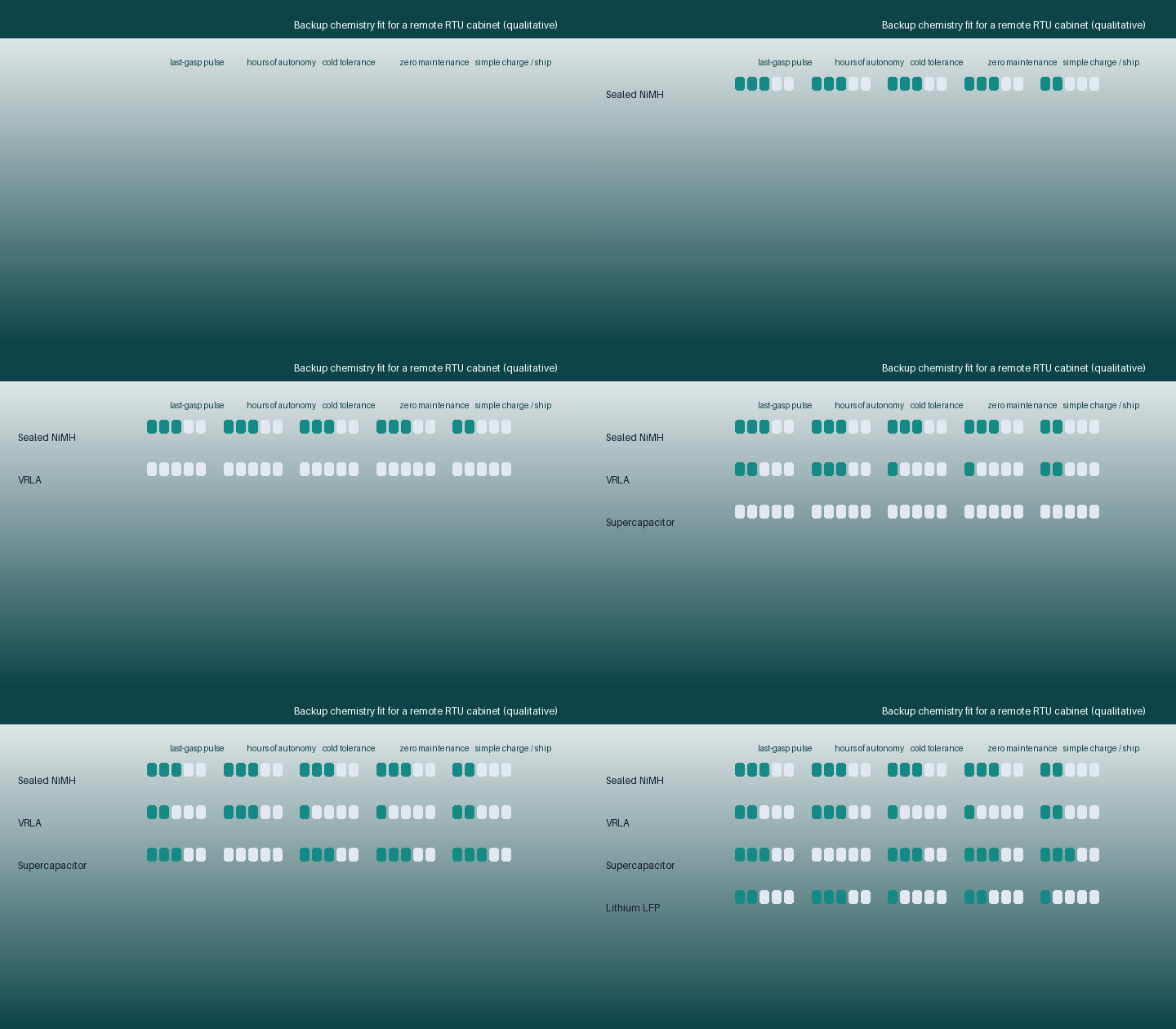
VRLA is the incumbent: low cost, familiar and available in large capacities, but heavy, sensitive to high-temperature float (which shortens life sharply), weak after cold soak, and it needs periodic internal-resistance checks and replacement on a maintenance cycle. Supercapacitors deliver essentially unlimited cycle life and very high power for the last-gasp and ride-through, but their energy per volume and euro is low and self-discharge is relatively high, so they are excellent for seconds of hold-up and poor for two days of autonomy.
Lithium iron phosphate and other lithium chemistries give high energy density and a long cycle life, but require a battery management system for cell balancing and protection, cannot be charged below freezing without risking damage, and carry more involved transport and protection considerations. Sealed NiMH sits between them: far lighter and more cold-tolerant than VRLA, vastly more energetic than supercapacitors, and simpler and more cold-forgiving than lithium, with IEC-standardised cells and non-lithium shipping. For a modest-power, wide-temperature, visit-rarely edge RTU, that balance is frequently the most robust choice; for a large station battery or a sub-second ride-through only, another chemistry may be right, and the selection should follow the quantified duty rather than habit.
Before integration, the design is validated against the real duty on the bench: an electronic load replays the recorded scan-and-radio waveform including transmit peaks while the pack is hot-soaked and cold-soaked; the last-gasp sequence is triggered at end-of-charge, end-of-discharge and minimum temperature to prove the fail telegram always completes; autonomy is measured against the Peukert prediction; and cycle and float-life runs confirm capacity and internal resistance stay within bounds over the service interval.
Vibration and terminal-integrity tests reflect pole-mounted and roadside cabinets, and the charger's termination and temperature behaviour are verified to prevent overcharge. Passing that programme produces a characterised pack - with a documented last-gasp guarantee, an autonomy curve over temperature and a predicted replacement interval - ready to be integrated under the standards and conformance campaign that the final paper describes.
Weijiang Power designs and manufactures sealed nickel-metal hydride cells and matched industrial packs for remote, off-grid and safety-related equipment, and supports OEM partners with IEC 61951-2 performance files, IEC 62133-2 safety evidence, pulse-load characterisation, wide-temperature testing and charger/pack co-validation. Tell us your duty cycle, peak current, temperature envelope, autonomy target and the standards your product must meet, and our engineers will specify a cell-and-pack combination that protects runtime, reliability and service life. Review the range on the products page.


