Underground in a gassy coal mine, a handheld or body-worn instrument operates in an atmosphere that can contain firedamp - predominantly methane - and any electrical spark or hot surface can, in principle, become an ignition source. Portable mining equipment is therefore designed to a uniquely demanding philosophy called intrinsic safety: not by containing an explosion inside a heavy enclosure, but by ensuring that every electrical and thermal energy level in the device, even under fault, is too low to ignite the surrounding gas. This first paper on nickel-metal hydride power for intrinsically-safe mining instruments explains the working principle and load profile of the two most common body-worn devices - the miner's cap lamp and the personal methane detector, often combined - and shows how intrinsic safety shapes their electrical design from the battery outward. It introduces the standards landscape: IEC 60079-0 for general requirements, IEC 60079-11 for protection by intrinsic safety 'i', the Group I classification for firedamp mines and the Ma/Mb equipment protection levels, expressed in markings such as Ex ia I Ma, with cap lamps additionally addressed by IEC 60079-35-1 and methane detectors by the gas-detector standards. Real certified products anchor the duty: a cap lamp rated Ex ia I Ma and IP65 delivering at least 7,500 lux initially and at least 5,000 lux after eleven hours, charging within ten hours for more than 500 cycles. The paper dissects the resulting load - a dominant LED driver, a catalytic or infrared methane sensor with its own current signature, a microcontroller, audible-visual-vibrating alarms and sometimes a radio - and explains why, in an intrinsically-safe device, the battery is the most tightly regulated component of all.
The miner carries a small set of life-critical portables: a cap lamp providing hands-free illumination for an entire shift; a personal methane detector that continuously samples the air and alarms at pre-set methane fractions; increasingly combined lamp-and-detector units; and auxiliary portables such as anemometers and personal gas monitors. Each is worn on the body for ten to twelve hours, must be light and robust, and must be certified for use where firedamp may be present.
Unlike fixed underground equipment, which can use heavy flameproof 'd' enclosures, a body-worn device cannot rely on mass and containment; it uses intrinsic safety 'i', guaranteeing that its internal circuits are incapable of causing ignition. That single choice drives every downstream decision, including the chemistry, construction and current limiting of its battery.
Intrinsic safety, defined in IEC 60079-11, limits open-circuit voltage, short-circuit current, stored capacitance and inductance and component surface temperatures so that, even after a defined number of faults, no spark or thermal effect can ignite the most easily ignitable mixture of the relevant gas group. Protection level 'ia' remains safe even with two faults and is used where the highest level is required, reflected for mining in the Group I, EPL Ma marking Ex ia I Ma; 'ib' tolerates one fault.
Methane has a defined minimum ignition energy and ignition temperature, and the standard's ignition curves and spark-test apparatus determine the maximum permitted current for a given voltage and circuit inductance. Because the battery is the primary energy reservoir, its maximum output under normal and fault conditions - including a short across its terminals and individual cell failures - is the starting point of the entire intrinsic-safety assessment, not an afterthought.
A cap lamp's load is dominated by its LED driver: a near-constant current sustaining main-beam illumination for the whole shift, with a lower auxiliary mode. Certified lamp specifications make the duty explicit - an initial illumination at one metre of at least 7,500 lux and at least 5,000 lux after eleven hours, a small auxiliary-light working current and a charge completed within ten hours for a cycle life beyond 500. That eleven-hour guarantee is a hard runtime target the battery must meet at end of life and at mine temperature.
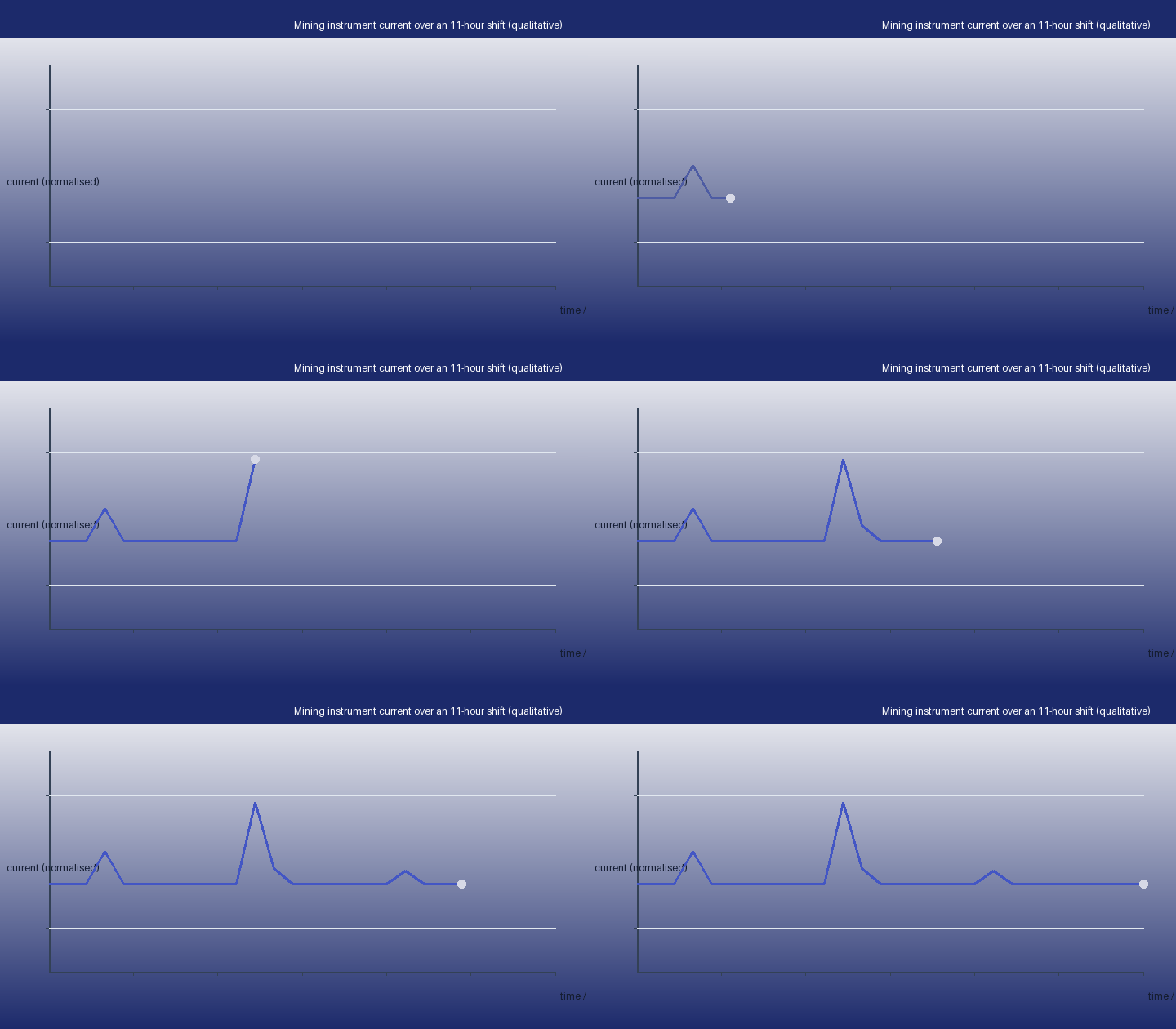
LED drivers in an IS design are themselves current-limited and fault-protected so a driver failure cannot dump stored energy into a spark. The first animated figure traces a representative instrument current across a shift - the steady lamp baseline, periodic methane-sensor samples and a short alarm peak - while the second layers the intrinsic-safety energy-limitation barriers that sit between the battery and the outside world.
A personal methane detector uses either a catalytic pellistor - a heated Wheatstone bridge whose elements burn methane and change resistance, drawing a significant steady heater current - or a non-dispersive infrared optical path that pulses an infrared source and samples periodically, trading sensor current for optics. A microcontroller reads the sensor, manages the display and drives a triple alarm - audible, visual and vibrating - whose simultaneous actuation is the instrument's sharpest current peak.
Detector performance standards require defined response time, accuracy and alarm reliability, and because a missed methane alarm is potentially fatal, the instrument must guarantee sensor and alarm function right down to a defined low-battery point, with a distinct, unambiguous low-battery warning well before measurement is compromised - the same 'safety reserve' logic as a teach pendant, but even more unforgiving.

Mining equipment belongs to Group I (as distinct from the Group II/III surface-industry classifications), with equipment protection levels Ma - equipment that remains energised and safe even in the rare event of a fault, for use where firedamp is likely - and Mb. In Europe the ATEX Directive 2014/34/EU is the legal framework and IECEx the international certification scheme, while in the United States MSHA runs its own approval regime; an IEC 60079-based design is the common technical core accepted across many mining regions.
Cap lamps carry a dedicated ignition-risk standard, IEC 60079-35-1, which deals specifically with preventing the caplight from becoming an ignition source in firedamp-susceptible mines (lighting performance is covered separately), while portable methane-detector performance follows the gas-detector standards. Understanding this map is essential before designing the battery, because each device's certificate constrains the cells and protection components that may legally be used.
The analysis produces a battery specification unlike any ordinary portable: cells of a type and construction accepted by the intrinsic-safety assessment, with maximum voltage and prospective short-circuit current bounded by design; series protection (fuses, blocking or current-limiting elements) that remains effective under fault; capacity for an eleven-hour shift at end of life and mine temperature with a guaranteed alarm reserve; mechanical protection against cell reversal, crush and electrolyte escape; and construction - often encapsulated and not user-openable in the hazardous area - that prevents sparking during use or battery exchange. The second paper turns this into a concrete intrinsically-safe NiMH pack and compares it honestly with lithium and lead-acid; the third maps the full IECEx/ATEX type-test campaign.
In an intrinsically-safe instrument the battery is not merely a power source; it is the upper bound of the energy the whole device can ever release, which is why its chemistry, protection and certification deserve the same rigour as the sensor that detects the gas.
Weijiang Power designs and manufactures sealed nickel-metal hydride cells and matched industrial packs for remote, off-grid and safety-related equipment, and supports OEM partners with IEC 61951-2 performance files, IEC 62133-2 safety evidence, pulse-load characterisation, wide-temperature testing and charger/pack co-validation. Tell us your duty cycle, peak current, temperature envelope, autonomy target and the standards your product must meet, and our engineers will specify a cell-and-pack combination that protects runtime, reliability and service life. Review the range on the products page.


