Because the teach pendant is the device a person holds while standing inside a robot's reach, its certification is dominated by functional safety, and its wireless battery is part of that safety case. The compliance campaign combines robot safety standards, machine electrical-safety standards, switchgear standards for the enabling controls, functional-safety standards for the wireless link, radio-type approval and environmental ruggedness, with the battery's own performance, safety and transport evidence layered underneath. This final paper maps that complete campaign for a nickel-metal hydride powered wireless pendant. It covers ISO 10218-1 and -2 for industrial robots and their integration, IEC 60947-5-8 for the three-position enabling device, ISO 13850 for emergency stop and the IEC 60204-1 stop categories, ISO 13849-1 for the performance level of the safety-related parts - including the wireless channel and the battery-dependent safety supply - and IEC 60204-1 provisions for wireless control of machinery, alongside collaborative-robot guidance in ISO/TS 15066. It then addresses radio approval, the IEC 60068 drop and environmental sequence and ingress protection, before closing with IEC 61951-2, IEC 62133-2 and UN 38.3 for the cells. The paper shows how the low-battery and loss-of-link behaviours are validated as safety functions, and why a supplier providing complete, lot-traceable NiMH documentation strengthens the pendant's safety case and simplifies global shipment of spare batteries.
ISO 10218-1 sets safety requirements for the industrial robot itself and ISO 10218-2 for the robot system and its integration, defining teach and automatic modes, the safeguarded-space workflow, the reduced teach speed and the requirement that motion in teach mode be gated by an enabling device. Collaborative applications add ISO/TS 15066. The pendant is assessed as part of this system: its mode selection, its enabling logic and its E-stop must satisfy the standard's protective-measure requirements.
Manufacturer guidance illustrates the detail - collaborative-robot manuals tie the three-position enabling pendant explicitly to ISO 10218-2 and describe the pendant E-stop as a Stop Category 1 that removes actuator power at monitored standstill, while warning that a non-safety-rated mode key switch must not be treated as a functional-safety element. The battery design must support all of these functions at any state of charge.
The three-position enabling device follows IEC 60947-5-8, with the released, middle and fully pressed positions producing the stop-enable-stop logic; the emergency stop follows ISO 13850 and is realised to the stop categories of IEC 60204-1. On a wireless pendant these mechanical and electrical functions are read by a safety input stage and transmitted over a safety-rated communication relationship, so their integrity is only as good as the chain that carries them.
Testing verifies that releasing or over-gripping the enabling device, or pressing E-stop, produces the required stop even under worst-case battery conditions - low state of charge, a simultaneous radio transmit peak and low temperature - because a stop command that fails precisely when the battery is weak is a dangerous latent fault.
The safety-related parts of the control system - enabling inputs, E-stop, the wireless safety telegram and the battery-dependent safety supply - are assigned a required performance level under ISO 13849-1, with redundancy, diagnostic coverage and mean time to dangerous failure considered. IEC 60204-1's provisions for wireless control require a defined response to loss of the communication link, typically an automatic stop if a valid command is not received within a watchdog time, and measures against unintended operation from another transmitter.
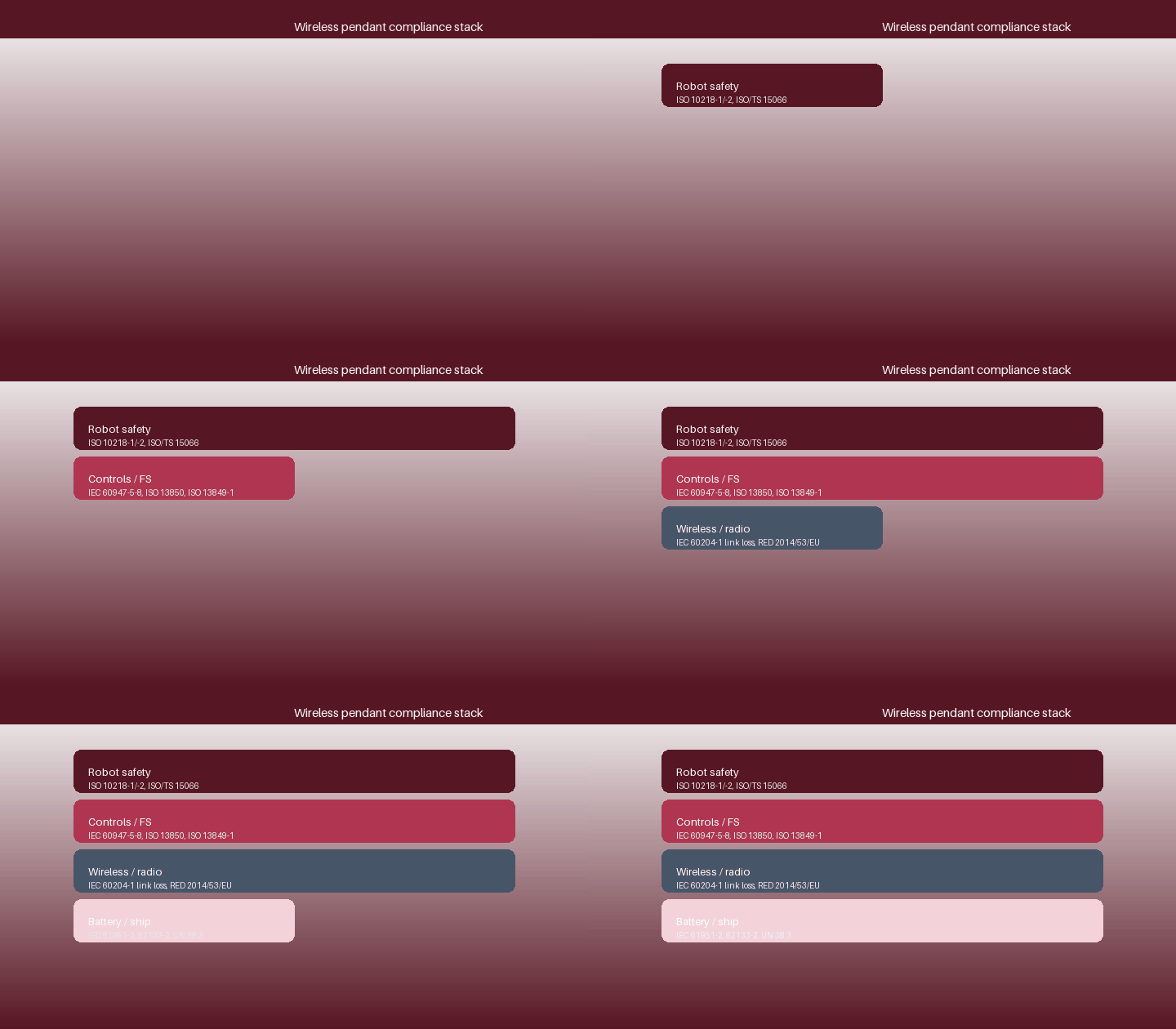
The battery enters this analysis as the power-supply element of a safety channel: it must guarantee the energy to transmit the stop and maintain the link for a defined time, and its low-battery behaviour is a safety function with its own diagnostic coverage. A separate, monitored safety reserve - the design from the second paper - is what lets the safety case claim deterministic behaviour rather than relying on an unmonitored cell. The first animated figure layers this standards stack; the second sequences the qualification campaign.
A wireless pendant is also a radio device and must satisfy the radio equipment regulations of its markets - the EU Radio Equipment Directive 2014/53/EU and equivalent regimes elsewhere - covering efficient spectrum use, EMC and electrical safety of the radio, plus coexistence with the factory's Wi-Fi and other wireless controls. The safety link is validated for latency, telegram loss and reconnection, demonstrating that worst-case interference triggers the safe stop rather than a delayed or corrupted motion command.
Because the radio is a major and bursty load, radio conformance is run at battery worst case to confirm transmit peaks do not cause supply resets that could be mistaken for link loss, tying the cell's internal-resistance behaviour directly to a clean radio approval.

A handheld that is dropped, gripped hard and used across a factory floor follows IEC 60068 for temperature, vibration, bump and free fall, and IEC 60529 for ingress protection appropriate to the environment. The battery pack is tested in those drops and thermal cycles to confirm cells stay retained, welds and connectors stay intact and no swelling, leakage or interruption of the safety supply occurs. EMC immunity under the IEC 61000 series is applied to the complete pendant.
These tests are deliberately repeated while the pendant is running on its NiMH pack at low charge and temperature extremes, the worst case for both radio and safety response, so ruggedness and functional-safety evidence are gathered together rather than on a bench supply that flatters the device.
The sealed NiMH cells carry their own dossier: IEC 61951-2 performance tests for capacity, charge retention, endurance and internal resistance, extended with high-rate pulse and wide-temperature data matching the pendant duty; IEC 62133-2 safety requirements under charge, forced discharge, external short, vibration, shock, free fall, thermal abuse, crush and pack-level faults; and UN 38.3 transport tests, under which non-lithium NiMH spare packs move under simpler rules than lithium spares - a practical advantage for worldwide robot-integrator service fleets.
The final technical file integrates the ISO 10218 robot-safety analysis, IEC 60947-5-8 and ISO 13850 evidence, the ISO 13849-1 performance-level argument including the battery-dependent safety supply and loss-of-link behaviour, radio and EMC approval, IEC 60068 and IEC 60529 results captured at battery worst case, and the three battery documents. A supplier that provides matched, abuse-tolerant NiMH cells with complete paperwork and support for the low-battery and loss-of-link safety tests removes the most variable element from that file, letting the pendant maker certify a wireless teaching device an operator can trust at arm's length from a moving robot.
Weijiang Power designs and manufactures sealed nickel-metal hydride cells and matched industrial packs for remote, off-grid and safety-related equipment, and supports OEM partners with IEC 61951-2 performance files, IEC 62133-2 safety evidence, pulse-load characterisation, wide-temperature testing and charger/pack co-validation. Tell us your duty cycle, peak current, temperature envelope, autonomy target and the standards your product must meet, and our engineers will specify a cell-and-pack combination that protects runtime, reliability and service life. Review the range on the products page.


