Certifying a portable instrument for a gassy underground mine is among the most rigorous approval processes in electronics, because the device is expected to be a non-ignition source even when faulty, in an atmosphere that can explode. This final paper maps the complete type-approval campaign for a nickel-metal hydride powered, intrinsically-safe cap lamp or methane detector. It begins with the explosive-atmospheres core: IEC 60079-0 for general equipment requirements and IEC 60079-11 for protection by intrinsic safety 'i', including the Group I classification for firedamp mines, the ia/ib protection levels and Ma/Mb equipment protection levels that produce markings such as Ex ia I Ma. It then covers the product-specific standards - IEC 60079-35-1, which addresses the ignition risk of cap lamps in firedamp-susceptible mines, and the gas-detector performance standards that govern methane measurement, response and alarms - and the certification frameworks that turn a tested design into a marketable product: the ATEX Directive 2014/34/EU in Europe, the IECEx international scheme and, in the United States, MSHA approval. Environmental ruggedness under IEC 60068 and ingress ratings such as IP65 complete the hardware evidence, while the cells carry IEC 61951-2 performance, IEC 62133-2 safety and UN 38.3 transport documentation. The paper shows how the battery is tested as an intrinsic part of the ignition-safety case - through spark-test apparatus, fault application and surface-temperature measurement - and why a supplier that provides complete, lot-traceable, construction-controlled NiMH documentation materially shortens the route to an IECEx/ATEX certificate.
IEC 60079-0 sets the general requirements for equipment used in explosive atmospheres - marking, temperature, materials, fasteners, connection facilities and the framework for the specific protection concepts - while IEC 60079-11 supplies the detailed construction and test rules for intrinsic safety 'i', covering component ratings, separation, infallible connections, encapsulation, and the voltage-current ignition curves against which circuits are assessed. The 2023 edition is the current reference.
For mining, the equipment is Group I and the certificate records the protection level (ia for safety through two faults) and the equipment protection level Ma or Mb, giving the marking Ex ia I Ma. Type testing deliberately applies faults - shorting and opening components, shorting the battery terminals - and confirms that under each defined fault no spark can ignite the prescribed methane mixture and no surface exceeds the permitted temperature. The battery pack and its protection sit at the centre of these fault tests.

Intrinsic safety is demonstrated, not merely argued: a standardised spark-test apparatus repeatedly makes and breaks the candidate circuit in a controlled explosive mixture while the worst-case battery supply - freshly charged, with its fuse and limiting elements in the fault configuration - is connected, and a pass requires no ignition across a defined number of operations. Surface temperatures are measured under fault to confirm they remain below the Group I ignition-temperature limit.
This is where a lower-voltage, current-limited NiMH design pays off: the prospective fault energy the test house must defeat is smaller and more predictable than for a high-voltage lithium pack, reducing the required limiting impedance (which would otherwise waste runtime) and simplifying the fault tables in the safety schedule. Every protection component is then documented as infallible with its rating and derating.
Cap lamps have a dedicated standard, IEC 60079-35-1, which specifies construction, testing and marking of caplights - including caplights with a connection for other equipment - for mines susceptible to firedamp, addressing only the risk that the caplight becomes an ignition source; photometric and runtime performance is specified separately. Real certified lamps illustrate the combined target: Ex ia I Ma construction, IP65 ingress protection, main-beam illumination of at least 7,500 lux initially and 5,000 lux after eleven hours, charging within ten hours and a cycle life beyond 500.
The approval therefore couples the ignition-safety assessment with an endurance and runtime programme run on the actual NiMH pack, demonstrating that the lamp sustains its certified light output and retains a functional low-battery behaviour across the rated cycle life rather than only when new.
A personal methane detector must satisfy both the intrinsic-safety standards and the gas-detector performance standards governing accuracy, response time, drift, alarm set-points and fault warning for Group I methane. The catalytic or infrared sensor is tested against calibrated methane mixtures, and the instrument must fail safe - raising a distinct fault or low-battery alarm - rather than silently under-reading, which makes the battery's alarm reserve and end-of-life behaviour part of detector performance, not just of power design.
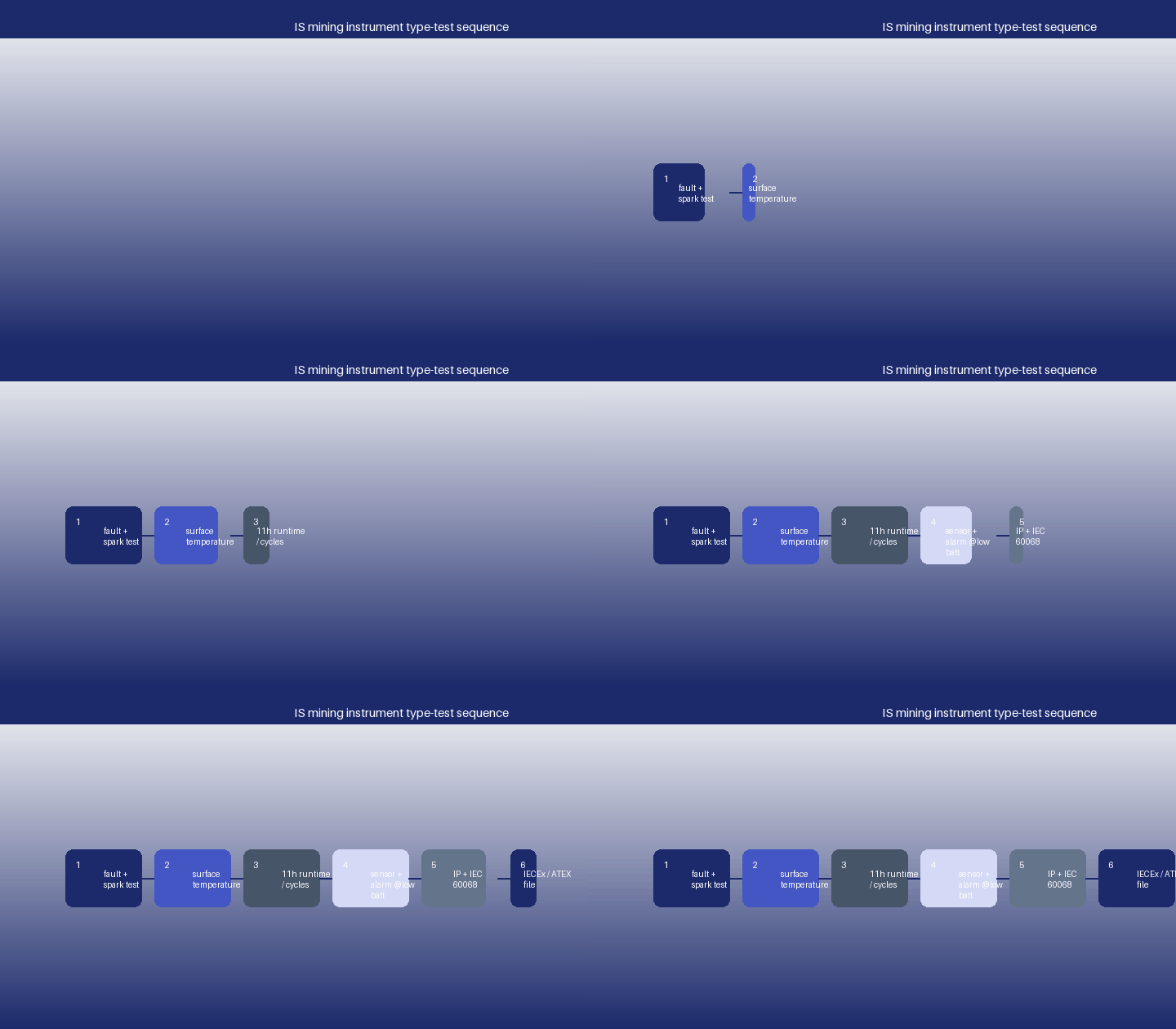
The first animated figure layers the full standards stack; the second sequences the type-test campaign. Detector tests are run at battery worst case to prove that sensing, triple alarm and low-battery warning all remain correct when the pack is cold and near its end-of-life capacity - the condition under which a real miner would otherwise be least protected.
In the European Union the ATEX Directive 2014/34/EU is the legal instrument, with an notified-body EU-type examination drawing on the harmonised EN 60079 series; IECEx provides a multilateral certification scheme based on the same IEC standards that eases global acceptance; and the United States uses MSHA approval for mining equipment, with NIOSH-derived intrinsic-safety criteria that parallel the IEC approach. A design built to IEC 60079 with a clean, documented safety schedule is the common denominator across them.
Ruggedness evidence - IEC 60068 temperature, vibration, shock and drop, and IEC 60529 ingress protection to IP65 or higher - is compiled alongside the explosion-protection file, with the tests repeated on the battery-powered instrument so the certificate reflects real, body-worn use.
The sealed NiMH cells contribute their own dossier: IEC 61951-2 performance tests for capacity, charge retention, endurance and internal resistance, extended with the low-temperature and cycle data the eleven-hour duty demands; IEC 62133-2 safety requirements under charge, forced discharge, external short, vibration, shock, free fall, thermal abuse, crush and pack-level faults; and UN 38.3 transport tests, under which non-lithium NiMH packs ship under simpler rules than lithium - a real advantage when deploying certified spare packs to remote mining operations.
The final safety schedule integrates the IEC 60079-0/-11 fault and spark analysis, the IEC 60079-35-1 or gas-detector evidence, ATEX/IECEx (and where needed MSHA) paperwork, ruggedness results and the three battery documents into one traceable package in which every cell, fuse and limiting component is specified and lot-controlled. A supplier that delivers matched, construction-stable NiMH cells with complete paperwork and support for the fault-spark and surface-temperature tests removes the most variable element from that schedule, letting the instrument maker certify a cap lamp or methane detector a miner can trust in an atmosphere that forgives nothing.
Weijiang Power designs and manufactures sealed nickel-metal hydride cells and matched industrial packs for remote, off-grid and safety-related equipment, and supports OEM partners with IEC 61951-2 performance files, IEC 62133-2 safety evidence, pulse-load characterisation, wide-temperature testing and charger/pack co-validation. Tell us your duty cycle, peak current, temperature envelope, autonomy target and the standards your product must meet, and our engineers will specify a cell-and-pack combination that protects runtime, reliability and service life. Review the range on the products page.


