From 18 August 2024, Regulation (EU) 2023/1542 requires certain batteries — stationary battery-management systems, LMT and EV batteries, and large industrial systems — to provide electronic state-of-health (SOH) and expected-lifetime data. Article 14 and Annex VII define the parameter set and access rules. Most small portable nickel-metal hydride (NiMH) cells are out of scope, but smart NiMH packs for professional equipment increasingly are not. This paper explains the data model and how to engineer it into NiMH-based systems.
Annex VII requires the BMS to make available five SOH quantities: remaining capacity relative to rated; remaining peak power capability; internal ohmic resistance (or impedance) and its trend; round-trip (charge/discharge) efficiency and its evolution; and the self-discharge rate and its evolution. Together they describe how far the battery has drifted from its new-battery state. For electric-vehicle applications the equivalent quantity is the state of charge certified for energy (SOCE), a harmonised energy-accounting figure defined by the implementing standards. The data must be readable through the battery management system, with access rules distinguishing the owner, independent operators and authorities.
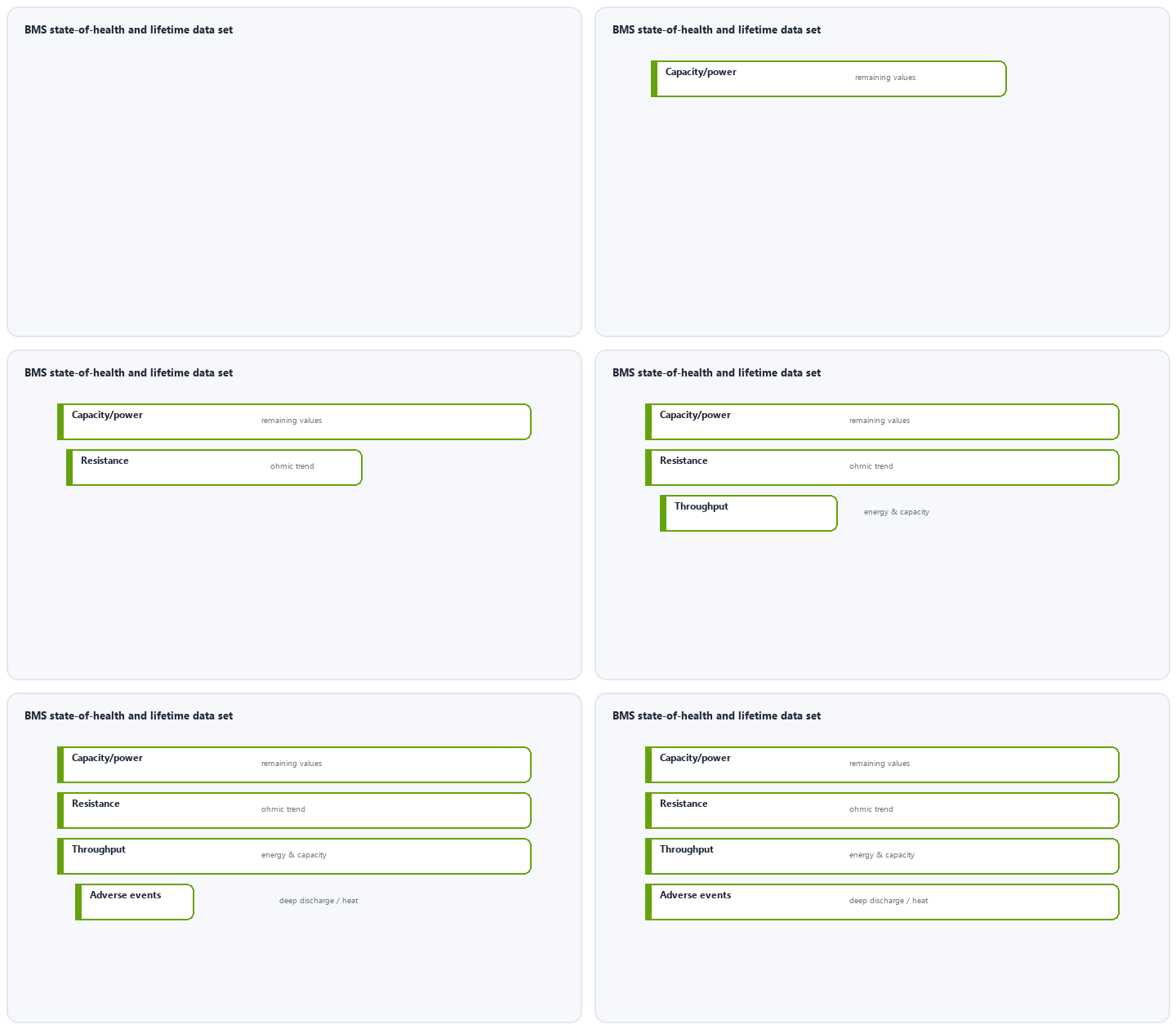
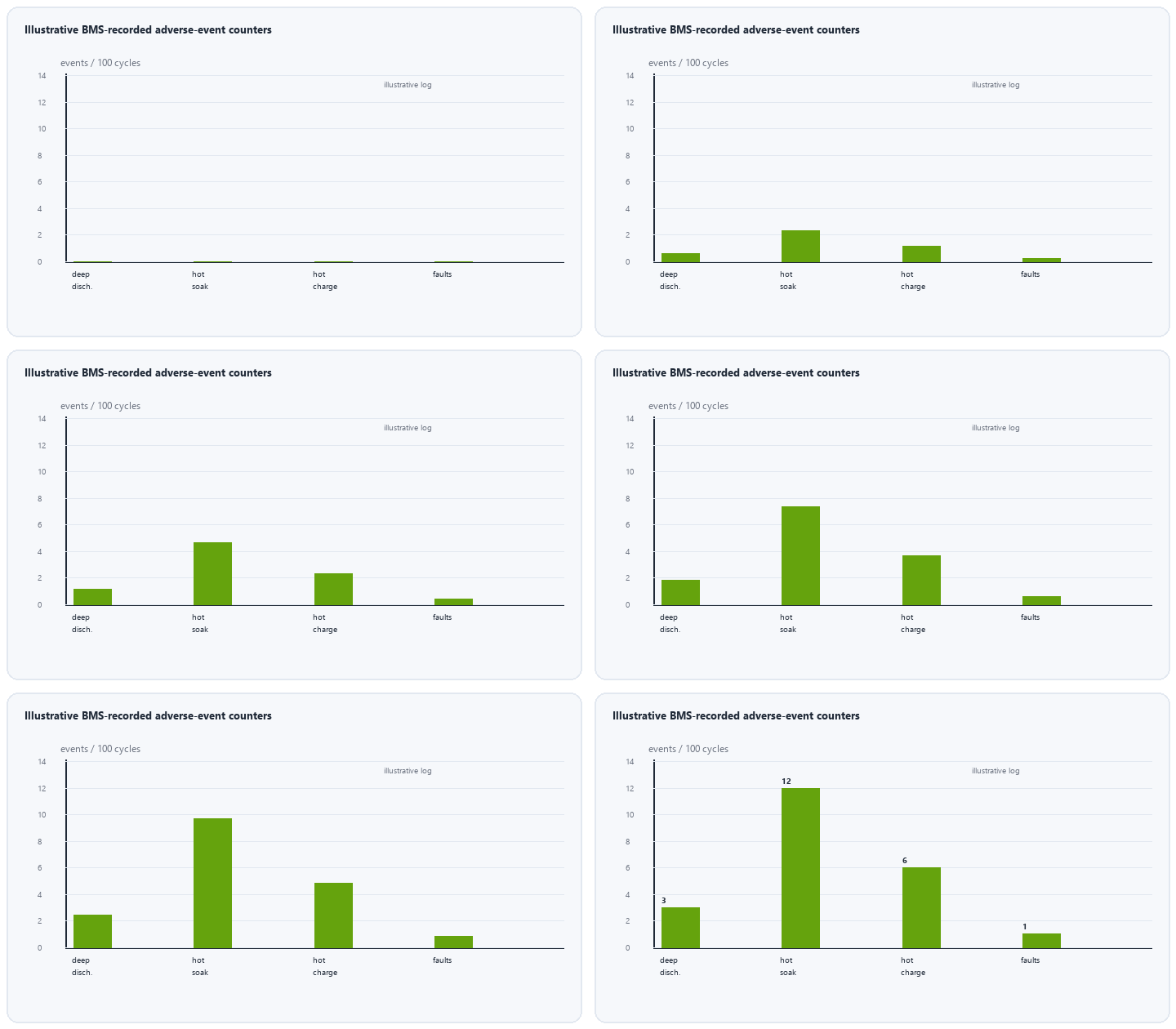
Alongside SOH, the system must retain lifetime data: manufacturing and commissioning dates; cumulative energy and capacity throughput; a harmful-event log counting deep discharges, exposure time at extreme temperatures, charging time at extreme temperatures, overcurrent and fault events; and the count of full equivalent cycles. These counters are the evidentiary backbone for warranty, second-life assessment and recycling triage. The animated log below illustrates an illustrative adverse-event counter panel — the point is not the numbers but the structure: each event type needs a threshold definition, a counter, non-volatile storage and a readout protocol.
NiMH packs do not need lithium-style SOC estimation from voltage curves — the chemistry offers a flat discharge plateau and a reliable -dV/dt and temperature-increase full-charge signature — but SOH accounting follows the same principles. Remaining capacity is updated from periodic reference discharge cycles or coulomb-counted throughput against a stored initial capacity; ohmic resistance is tracked by pulse-response measurements at fixed SOC and temperature; efficiency follows from integrated charge versus discharge energy; self-discharge is estimated from open-circuit rest periods. Because heat dominates NiMH ageing, the temperature-exposure counters (time above 45 °C, charge time at high temperature) are the most predictive lifetime variables and should be logged at conservative thresholds.
The Regulation requires SOH and lifetime data to be accessible to the battery owner and, on request, to independent operators such as repairers and second-life companies, without unfair restriction. Protocol choices (SMBus, CAN, BLE GATT profiles) are not mandated, but the data dictionary must be documented and discrimination-free. For professional NiMH packs — medical carts, robotic platforms, stationary backup — exposing a documented BMS log both satisfies the rule where it applies and supports the Annex IV durability evidence: field counters corroborate laboratory cycle-life claims.
First decide scope: a passive AA holder is portable and needs no BMS data; a 24 V smart NiMH pack in professional equipment may be industrial and benefit from, or require, the Annex VII set if it sits in a managed stationary or LMT-type system. Then implement: a fuel-gauge or protection IC with non-volatile event counters; defined thresholds for deep discharge, over-temperature and charge conditions; periodic reference-capacity updates; a readout interface with an owner-accessible data dictionary; and calibration instructions in the service manual. Over-claiming precision is a risk — state confidence intervals and the conditions under which estimates update.
Weijiang Power designs smart NiMH packs with Annex VII-aligned monitoring: coulomb-counted SOH, pulse-based resistance tracking, temperature and deep-discharge event logs, full-equivalent-cycle counters and documented SMBus/CAN/BLE readouts. Send your system architecture and whether the pack is portable or industrial and we deliver the BMS specification, data dictionary and the durability test records that validate the algorithms.


