When a transport-category aircraft loses both engine-driven generators at altitude, the flight crew do not simply "switch to the battery." Airborne emergency electrical power is a deliberately tiered system, built from several sources that come online in a defined sequence and feed a deliberately small set of essential buses, and the battery is only one link in that chain. Understanding where the battery sits - what it must power, for how long, and under what current profile - is the difference between a pack that is certified and useful and one that is merely a catalogue cell in an aviation enclosure. This Paper A, the operating-profile and principles instalment of our aircraft emergency-power series, traces the architecture from the main generators down to the dedicated emergency battery power supplies (EBPS) that keep cabin and exit lighting and critical equipment alive, then maps the load profile the chemistry actually sees. It draws on the certification framework that governs permanently installed rechargeable systems - RTCA DO-311 and DO-311A, FAA TSO-C179 and the installation guidance of AC 20-184A - as well as the separate standards used for emergency-lighting power, and on a concrete, certified example: the nickel-metal hydride (NiMH) emergency battery power supplies that now directly replace legacy nickel-cadmium (NiCad) units on business and commercial aircraft. Papers B and C will cover sizing, pack design and qualification; here the goal is to establish the operating regime honestly, including the important boundary that NiMH occupies a certified role in emergency lighting and critical-equipment supplies rather than as the main engine-starting ship battery.
A modern airliner generates electrical power from several independent sources, and the emergency architecture is organised so that the loss of any one, or even all of the primary sources, still leaves a path to the instruments. In normal flight the engine-driven generators - each on the order of 90 kVA on a single-aisle airliner - supply the entire network, with the auxiliary power unit (APU) generator available as a backup in flight and as the principal source on the ground. If both engine generators fail, the first large-scale fallback is not the battery but the ram air turbine (RAT), a windmilling propeller that deploys automatically into the slipstream above a minimum airspeed and, through a hydraulic circuit, drives a dedicated emergency generator that is far smaller than the main generators - on the Airbus A320 family rated at about 5 kVA, three-phase 115/200 V. The RAT supplies the bulk of the continued emergency electrical and, on many types, hydraulic energy for as long as the aircraft is flying. The ship batteries sit underneath that layer: they bridge the few seconds between generator loss and the RAT coming online, feed the DC essential network in configurations where the emergency generator is not running (notably with the landing gear down low in the approach), and start the APU. On the A320 the two main batteries are 23 Ah, 24 V NiCd units that can support the essential DC services for roughly 30 minutes. A final, distributed layer is made of the dedicated emergency battery power supplies installed specifically to power cabin and exit lighting and selected critical equipment independently of the main battery. This separation exists because no single chemistry or unit is best at every job: engine starting demands very high current for a few seconds, RAT-gap bridging demands a robust medium-current pulse, and emergency lighting demands a long, low, highly reliable sustained draw after years of quiet stowage.
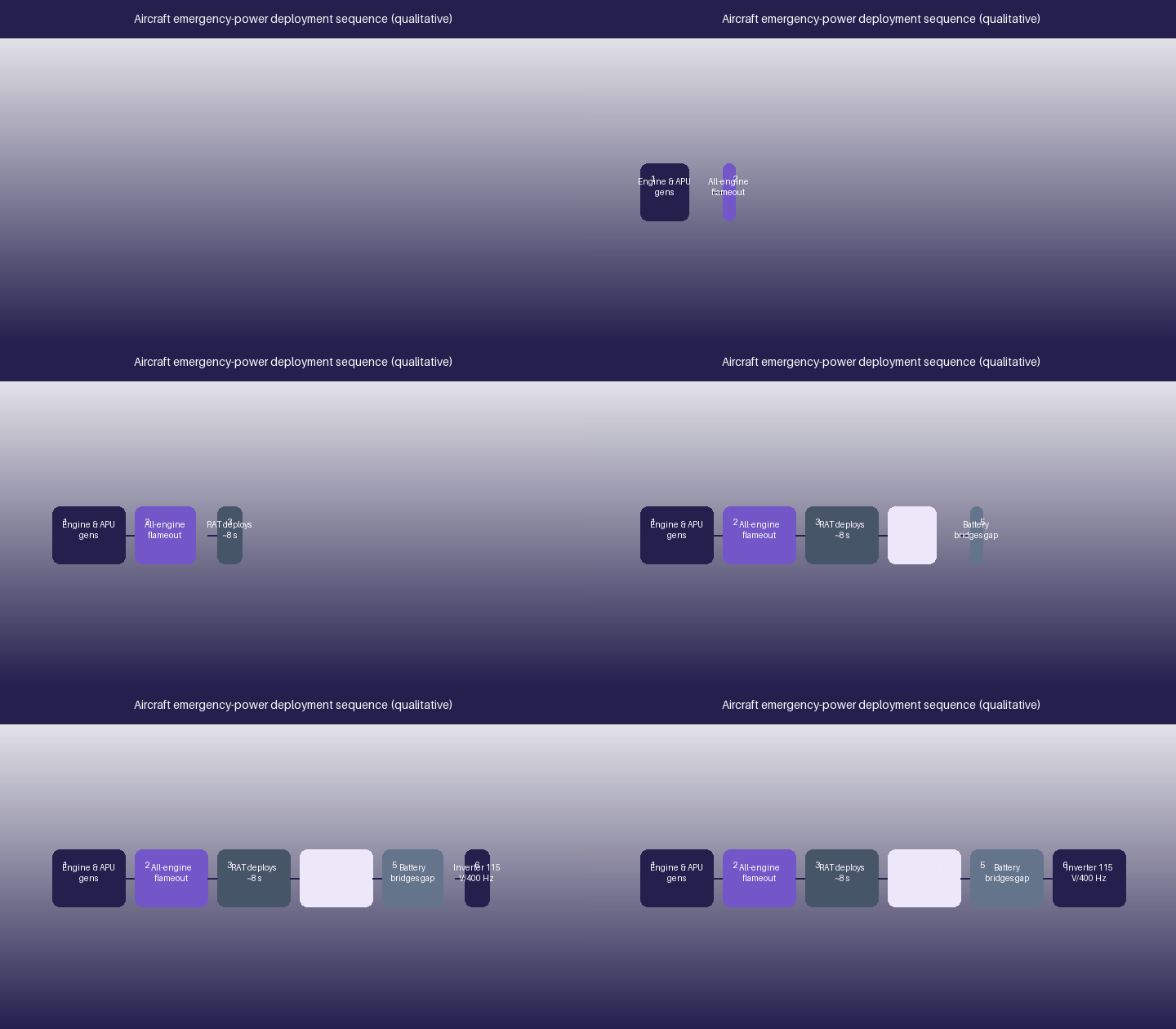
The emergency system is triggered by an event rather than by a crew decision in the first instance: an all-engine flameout or fuel starvation, the simultaneous loss of both engine generators, a serious electrical fault that opens the generator contactors, or any configuration in which the aircraft electrical network detects that no main AC source is available. The sequence then unfolds rapidly and largely automatically. Non-essential loads are shed by the electrical load-shedding logic so that the diminished emergency capacity is reserved for flight-critical equipment; galley supplies, in-flight entertainment and comfort loads drop off first. The RAT is released automatically and, once the airflow brings it up to speed, its emergency generator is connected to the essential network. There is a short but critical transition - on the order of seconds, frequently cited around eight seconds on the A320 family - between the loss of the main generators and the RAT emergency generator coming online, and it is the ship batteries that must carry the essential DC network across that gap without interruption. Where the emergency generator is unavailable, for example during the final approach with gear down, the batteries continue to supply the essential network directly. The first animated figure sets out this deployment sequence in order; the timing is qualitative and varies by aircraft type and configuration, but the ordering of shedding, RAT deployment, battery gap-bridging and essential-bus supply is common across transport-category design.
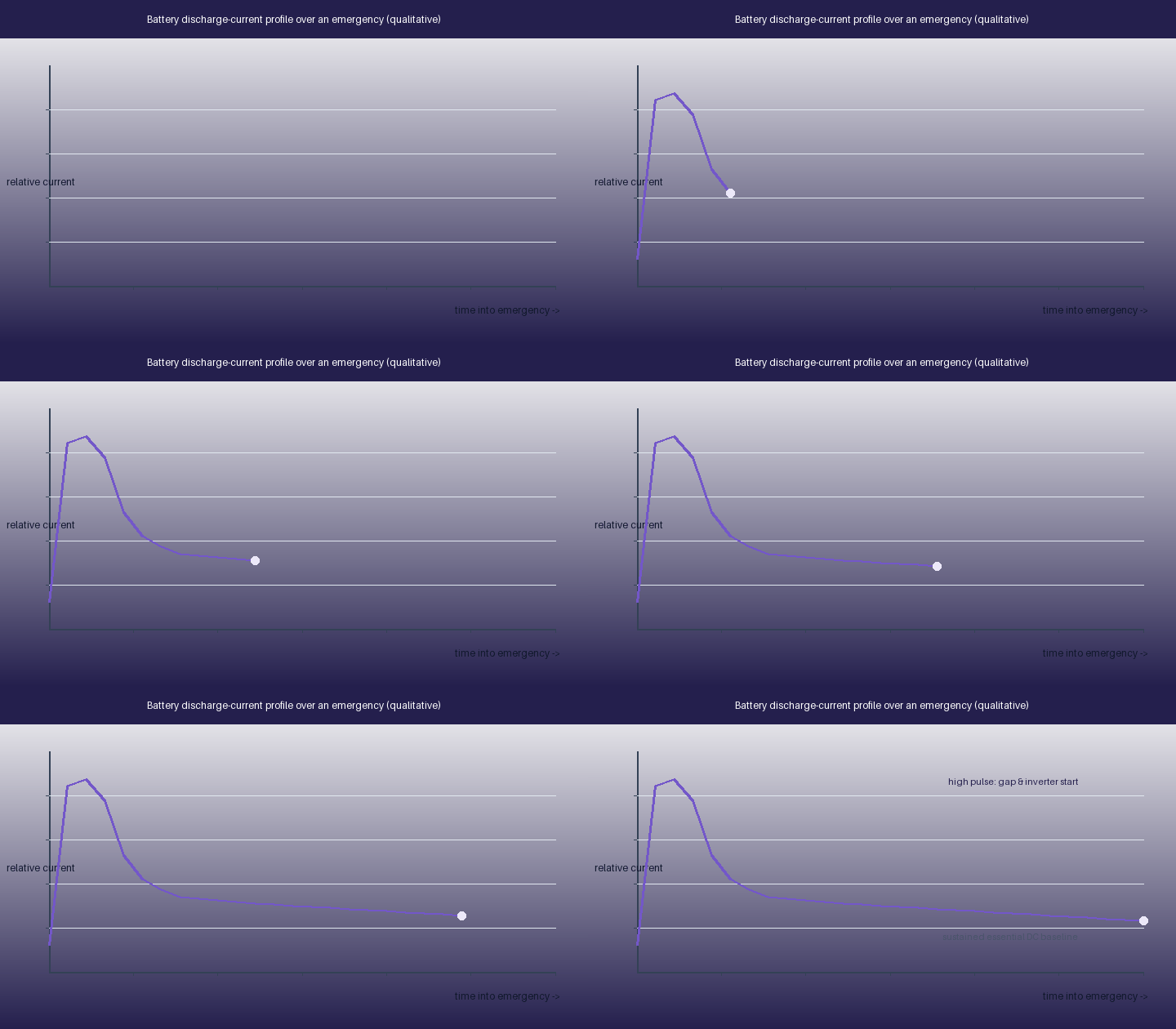
The current a battery is asked to deliver during a real emergency is not a flat discharge, and sizing a pack against a single average current is a classic design error. The profile has two distinct phases. It opens with a short, relatively high-current pulse at the moment the emergency configuration is established: battery contactors close, the static inverter starts and its input capacitors charge (an inrush that can briefly be several times the running current), and the DC essential bus is picked up. On systems that also use the battery for APU starting, a separate and much larger cranking pulse - hundreds of amperes for a few seconds - belongs to the main ship battery rather than to a lighting supply. Once the network has settled, the profile transitions to a long, low, slowly varying sustained draw. With non-essential loads already shed, the battery powers only the retained equipment: the standby or integrated standby instrument, the captain-side primary flight and navigation displays, the upper engine/warning display, the essential flight-control provisions, emergency lighting and a single VHF radio. The current in this sustained phase is modest and comparatively steady, declining gently as bus voltages and display loads evolve, and it must be maintained without the battery voltage sagging below the equipment cut-off for the required endurance. The second animated figure shows this profile qualitatively - the high starting pulse followed by the long low baseline - and it is illustrative of the regime rather than a measurement of any specific aircraft.
The reason the sustained draw can be kept so low is that, in an emergency, only the essential buses remain powered, and the architecture is explicit about which loads survive. The aircraft distinguishes AC and DC essential buses and, within them, between loads that are always retained on the essential bus and lower-priority "shed" loads that are dropped automatically as the configuration degrades. Where the emergency generator or a transformer-rectifier unit is available, it feeds the AC and DC essential buses; when the battery alone carries the network, its DC is turned back into alternating current by a static inverter. On the A320 family a 1,000 VA static inverter transforms the battery DC into single-phase 115 V, 400 Hz AC, automatically activated in the emergency configuration, so that the attitude, airspeed and altitude instruments that expect AC can continue to run. The dedicated emergency battery power supplies serve a parallel but independent function: they are installed to guarantee cabin and exit-path lighting and specific critical equipment even if the main ship battery is occupied or depleted, and they are kept charged from the aircraft power bus so that they are always at full readiness. Keeping the lighting supply electrically separate from the main battery is a redundancy decision - it ensures that the path to the exits cannot be darkened by a fault elsewhere - and it is precisely this role, with its long, low, stowage-dominated duty, for which modern NiMH emergency supplies have been certified as direct replacements for older NiCad units.
Four battery chemistries appear across the airborne emergency system, each matched to a different role, and it is important not to conflate them. The main ship batteries on older and current airliners are predominantly vented NiCd, valued for high mechanical robustness, high short-duration current and tolerance of abuse, but carrying the familiar penalties of memory effect, the need for regular deep capacity checks, and water and cell-balance maintenance; some aircraft use valve-regulated lead-acid units. Permanently installed rechargeable lithium main batteries are a newer option, governed by RTCA DO-311 and DO-311A minimum operational performance standards and authorised under FAA TSO-C179 (with CAAC CTSO-C179 equivalents), installed using the guidance of AC 20-184A. Because lithium introduces thermal-runaway behaviour that NiCd and lead-acid do not, regulators have issued special conditions for lithium installations, and the high-profile 2013 battery events on the Boeing 787 illustrate why the cell, module and system-level thermal-runaway testing described in DO-311 and supporting NASA methods is taken seriously. The fourth chemistry is nickel-metal hydride, and here a real, certified product defines the role. The True Blue Power TS32 series (32 watt-hours) and TS56 (56 watt-hours) emergency battery power supplies use NiMH chemistry to provide DC power for emergency lighting and critical equipment after a main-power failure; they are certified to TSO-C173a, RTCA DO-293A and RTCA DO-160G as direct replacements for legacy NiCad units from manufacturers such as Radiant across Embraer, Bombardier, Boeing and Airbus applications. Using NiMH eliminates the memory effect of the NiCad units they replace, and capacity checks are required only every two years rather than at the older, more frequent interval. The TS56, for example, accepts a 20-30 VDC input, provides a 24.6 VDC nominal output at up to 3 A, weighs about 2.9 lb and delivers on the order of 132 minutes at a 1 A discharge. The positioning is deliberate and should be stated plainly: certified NiMH is established for emergency-lighting and critical-equipment supplies, where its aqueous, non-flammable potassium-hydroxide electrolyte means it does not exhibit lithium-style thermal runaway; it is not being marketed as the high-current engine-starting ship battery, a role that still belongs to NiCd and, increasingly, certified lithium.
An aviation battery does not see a benign, room-temperature world, and the pack must be qualified against the airborne environment defined in RTCA DO-160, the same environmental conditions document cited alongside the emergency-supply certifications above. The relevant categories cover the extremes the unit will realistically meet in its installed location: wide operating and storage temperature ranges, from cold-soak conditions at altitude and on winter ramps to prolonged heat in equipment bays and sun-heated cabins; the low pressure and reduced cooling of altitude, including rapid-decompression behaviour; the vibration spectrum of the airframe; and shock and crash-safety provisions. These conditions interact with the chemistry in ways the designer must respect. NiMH cells lose charge acceptance at low temperature, so charging is confined to a temperature window and managed by the charge control rather than forced in cold conditions; at altitude the pack must vent safely under reduced pressure without drying out or losing cells; and the aqueous chemistry, while it removes the thermal-runaway hazard of lithium, still requires pressure-relief paths and protection against short circuit and overcharge. The charge regime that keeps an emergency supply ready - constant-current charging with negative delta-V (-dV/dt) termination, a delta-temperature-over-time (dT/dt) backup and an absolute temperature cut-off - is therefore specified as much for the DO-160 environment as for cycle life. The separate emergency-locator transmitter (ELT), which transmits on 406 MHz and is certified under TSO-C126, illustrates the same environmental discipline with its own battery: its pack is replaced at the manufacturer-stated interval, commonly on the order of five to six years, and in US operation under FAR 91.207 it must be replaced once the transmitter has been in use for more than one cumulative hour.
Our engineering approach follows directly from the operating profile established above. We treat the emergency-lighting and critical-equipment supply as a distinct product from any high-current ship battery, and we size it against the two-phase profile - the short inverter-start and contactor pulse and the long low sustained draw - rather than a single nominal current. Cells are selected for stable voltage under the sustained essential-bus load and for low self-discharge, so a supply that has sat untouched for months is still at full readiness when the aircraft bus calls on it; welded-tab construction and a defined venting path protect against the vibration and reduced-pressure conditions of DO-160, and the charge control uses -dV/dt termination with a dT/dt backup and an absolute temperature cut-out so that the pack is maintained at full charge without overcharge. Because the chemistry is NiMH rather than lithium, the pack carries no thermal-runaway hazard and sits outside the lithium transport regime, which materially simplifies shipping spare packs to line stations and operator depots. Every pack is delivered with a traceable evidence file - cell performance data, nickel-system safety results, a pack drawing showing series count, welded tabs, venting and any thermal protection, charge-control specification and a chemistry/transport statement - so that an OEM or an operator seeking a direct replacement for a legacy NiCad emergency supply can certify and install it with a defensible dossier rather than an unsupported claim.
Weijiang Power manufactures sealed nickel-metal hydride cells and matched industrial packs for emergency lighting and critical-equipment power supplies, alongside a broad range of industrial NiMH packs for transport, marine and medical equipment, and supplies OEM and operator partners with a complete evidence file: cell performance reports, nickel-system safety reports, high-rate and cold-temperature characterisation, welded-tab pack drawings showing venting and thermal protection, charge-control co-validation and a clear non-lithium transport statement. Send us your emergency-supply load profile, the inverter and contactor starting pulse, the sustained essential-bus current, the installed temperature and altitude envelope, the required endurance and the standards the unit must meet, and our engineers will size, qualify and document a pack that stays at full readiness through years of service. Review the cell and pack range on the products page.


